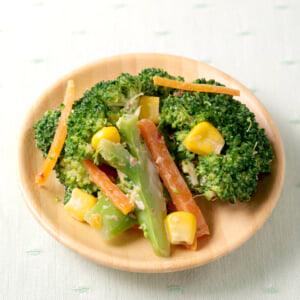
Broccoli and Tuna Salad
ブロッコリーとツナのサラダ
 By Aoi, licensed nutritionist · From a Japanese preschool lunch menu
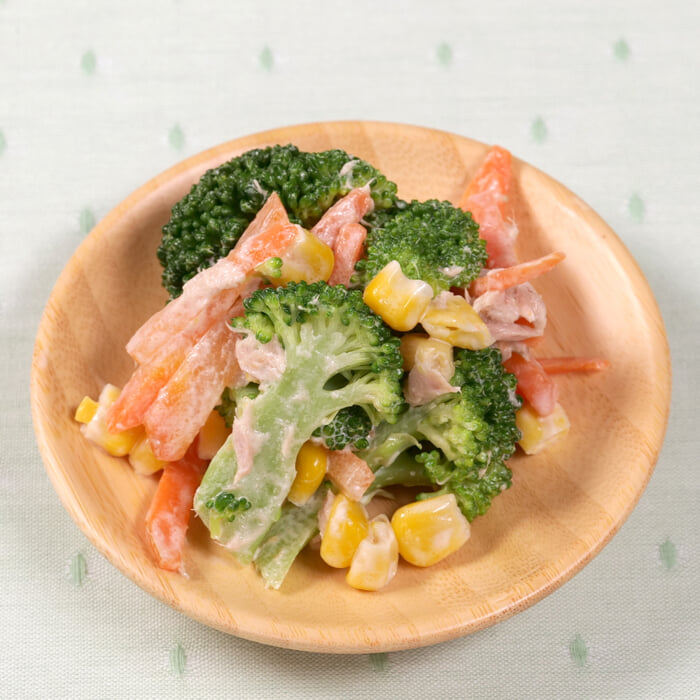
This is one of the most dependable side dishes on our preschool lunch menu: tender broccoli florets, sweet corn and thin strips of carrot, brought together with tuna and a spoonful of mayonnaise. The tuna gives the vegetables a savory, familiar flavor that helps even broccoli-wary children clean their plates. In school kitchens we use Mayodore, an egg-free mayonnaise-style dressing, and the salad is made without egg, milk or wheat. Regular mayonnaise works just as well at home, though it contains egg.
Added. Open the recipe helper (bottom right) → ☰ Menu → 🛒 Shopping list to see the ingredients for your family size.
Printing uses the number of adults and children set under Ingredients, so set those first.
Ingredients
Amounts for 1 child (1 serving). An adult counts as 2 servings.
One serving here is 1.5× the portion served to a child in a Japanese preschool, sized for Western appetites. An adult counts as two servings. Tap an ingredient to check it off.
Ingredients
- 33 gbroccoli
- 13.5 gcarrot
- 13.5 gwhole kernel corn (canned or frozen)
- 6.6 gcanned tuna (in oil)
Seasonings
- 6.6 gegg-free mayonnaise (Mayodore)A Japanese egg-free mayonnaise-style dressing. Substitute: Any egg-free or vegan mayonnaise.
- 0.2 gsalt
About the Japanese ingredients in this recipe
- egg-free mayonnaise (Mayodore) (マヨドレ)
- A Japanese egg-free mayonnaise-style dressing. Substitute: Any egg-free or vegan mayonnaise.
Directions
- 1
Cut the broccoli into small florets. Boil it, then let it cool as is, without rinsing.
- 2
Cut the carrot into short, thin strips. Boil the carrot and the corn separately (canned corn needs no heating), then rinse under running water to cool.
- 3
Drain the oil from the canned tuna.
- 4
Squeeze the carrot and corn from step 2 to remove excess water, then toss with the broccoli from step 1, the tuna from step 3, and the seasonings.
Broccoli turns watery if you rinse it in water, so let it cool as is instead.
Nutrition
| Per | 1 serving | 1 adult serving | Your total |
|---|---|---|---|
| Energy | 81 kcal | 162 kcal | 81 kcal |
| Protein | 3.5 g | 6.9 g | 3.5 g |
| Fat | 5.6 g | 11.1 g | 5.6 g |
| Carbohydrates | 6.3 g | 12.6 g | 6.3 g |
| Fiber | 2.6 g | 5.1 g | 2.6 g |
| Salt equivalent | 0.3 g | 0.6 g | 0.3 g |
| Calcium | 21 mg | 42 mg | 21 mg |
| Iron | 0.5 mg | 0.9 mg | 0.5 mg |
| Potassium | 226.5 mg | 453 mg | 226.5 mg |
| Energy | Protein | Fat | Carbs | Fiber | Salt equiv. | Calcium | Iron | Potassium | |
|---|---|---|---|---|---|---|---|---|---|
| 1 serving | 81 kcal | 3.5 g | 5.6 g | 6.3 g | 2.6 g | 0.3 g | 21 mg | 0.5 mg | 226.5 mg |
| 1 adult serving | 162 kcal | 6.9 g | 11.1 g | 12.6 g | 5.1 g | 0.6 g | 42 mg | 0.9 mg | 453 mg |
Values are per serving (1.5× the Japanese preschool portion); an adult serving is double. They were calculated by a licensed Japanese nutritionist using the Standard Tables of Food Composition in Japan. "Salt equivalent" is sodium × 2.54, the standard Japanese measure. Allergen flags cover egg, milk and wheat only and come from the nutritionist's records. Soy sauce and miso are made with wheat but are usually allowed on Japanese wheat-free school menus, so check with your doctor.