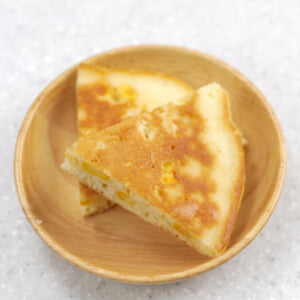
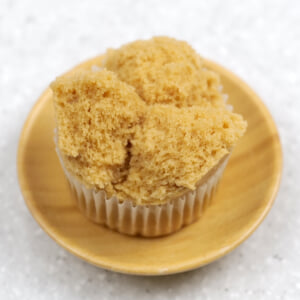
Rice Flour Banana Mushipan (Steamed Cake)
米粉バナナ蒸しパン · Komeko Banana Mushipan
 By Aoi, licensed nutritionist · From a Japanese preschool lunch menu
Mushipan, or Japanese steamed cake, is a classic preschool snack: soft, moist and just lightly sweet, so even the youngest children can manage it easily. This version uses rice flour and sweetened soy milk instead of wheat flour, eggs and milk, and gets most of its flavor from ripe mashed banana. A few banana slices on top make each little cake look special, and because everything is mixed in one bowl and steamed in about 10 minutes, it is an easy treat to make with kids.
Added. Open the recipe helper (bottom right) → ☰ Menu → 🛒 Shopping list to see the ingredients for your family size.
Printing uses the number of adults and children set under Ingredients, so set those first.
Ingredients
Amounts for 1 child (1 serving). An adult counts as 2 servings.
One serving here is 1.5× the portion served to a child in a Japanese preschool, sized for Western appetites. An adult counts as two servings. Tap an ingredient to check it off.
Ingredients
- 22.5 gbanana
- 37.5 grice flour
Seasonings
- 1.5 gbaking powder
- 9.5 gsugar
- 37.5 gsweetened soy milk (Japanese chosei tonyu)Japanese 'prepared' soy milk that is lightly sweetened and flavored to taste milder than plain soy milk. Substitute: Regular (original, lightly sweetened) soy milk from the supermarket.
- 7.5 gvegetable oil
About the Japanese ingredients in this recipe
- sweetened soy milk (Japanese chosei tonyu) (調製豆乳)
- Japanese 'prepared' soy milk that is lightly sweetened and flavored to taste milder than plain soy milk. Substitute: Regular (original, lightly sweetened) soy milk from the supermarket.
Directions
- 1
Slice some of the banana into rounds to decorate the tops, then mash the rest with a potato masher.
- 2
Put the rice flour, sugar and baking powder in a bowl and mix with a whisk.
- 3
Add the soy milk and the mashed banana from step 1, and mix.
- 4
Pour the batter into a tray or cups, top with the banana slices and arrange in a steamer. Cover and steam over high heat for about 10 minutes.
Nutrition
| Per | 1 serving | 1 adult serving | Your total |
|---|---|---|---|
| Energy | 283.5 kcal | 567 kcal | 283.5 kcal |
| Protein | 3.8 g | 7.5 g | 3.8 g |
| Fat | 9.1 g | 18.3 g | 9.1 g |
| Carbohydrates | 47.6 g | 95.1 g | 47.6 g |
| Fiber | 1 g | 2.1 g | 1 g |
| Salt equivalent | 0.3 g | 0.6 g | 0.3 g |
| Calcium | 52.5 mg | 105 mg | 52.5 mg |
| Iron | 0.5 mg | 0.9 mg | 0.5 mg |
| Potassium | 220.5 mg | 441 mg | 220.5 mg |
| Energy | Protein | Fat | Carbs | Fiber | Salt equiv. | Calcium | Iron | Potassium | |
|---|---|---|---|---|---|---|---|---|---|
| 1 serving | 283.5 kcal | 3.8 g | 9.1 g | 47.6 g | 1 g | 0.3 g | 52.5 mg | 0.5 mg | 220.5 mg |
| 1 adult serving | 567 kcal | 7.5 g | 18.3 g | 95.1 g | 2.1 g | 0.6 g | 105 mg | 0.9 mg | 441 mg |
Values are per serving (1.5× the Japanese preschool portion); an adult serving is double. They were calculated by a licensed Japanese nutritionist using the Standard Tables of Food Composition in Japan. "Salt equivalent" is sodium × 2.54, the standard Japanese measure. Allergen flags cover egg, milk and wheat only and come from the nutritionist's records. Soy sauce and miso are made with wheat but are usually allowed on Japanese wheat-free school menus, so check with your doctor.