Potato Soup
ポテトスープ
 By Aoi, licensed nutritionist · From a Japanese preschool lunch menu
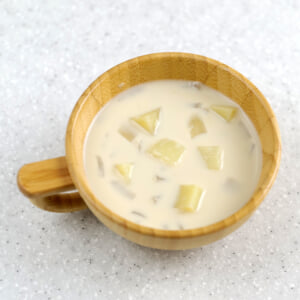
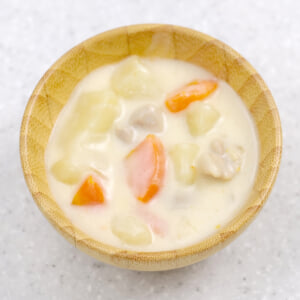
This is a light, clear soup of potato and onion simmered in consommé broth, the kind of gentle side soup that turns up often on Japanese preschool lunch menus. Cutting the vegetables into small 1 cm dice means they cook through until soft and fit neatly on a toddler's spoon. With just a light touch of salt and pepper at the end, the gentle sweetness of the onion and the comfort of the potato are all the flavor children need. It is made without egg or milk, and it pairs nicely with just about any main dish.
Added. Open the recipe helper (bottom right) → ☰ Menu → 🛒 Shopping list to see the ingredients for your family size.
Printing uses the number of adults and children set under Ingredients, so set those first.
Ingredients
Amounts for 1 child (1 serving). An adult counts as 2 servings.
One serving here is 1.5× the portion served to a child in a Japanese preschool, sized for Western appetites. An adult counts as two servings. Tap an ingredient to check it off.
Ingredients
- 30 gpotato
- 15 gonion
Seasonings
- 150 gwater
- 0.5 gallergen-free consommé powderJapanese consommé is a Western-style bouillon powder or cube. This kind is made without egg and milk, but the recipes that use it list wheat in their allergens, so check the label if you avoid wheat. Substitute: A chicken or vegetable bouillon powder or cube made without egg, milk or wheat (check the label).
- 0.4 gsalt
- to tastepepper
About the Japanese ingredients in this recipe
- allergen-free consommé powder (コンソメ,アレルゲン不使用)
- Japanese consommé is a Western-style bouillon powder or cube. This kind is made without egg and milk, but the recipes that use it list wheat in their allergens, so check the label if you avoid wheat. Substitute: A chicken or vegetable bouillon powder or cube made without egg, milk or wheat (check the label).
Directions
- 1
Cut the potato and onion into 1 cm dice.
- 2
Put the water, consommé, potato, and onion in a pot and simmer. (If there is only a little liquid, cover with a drop lid and steam-simmer.)
- 3
Once the vegetables are soft, add the salt and pepper and simmer briefly.
Nutrition
| Per | 1 serving | 1 adult serving | Your total |
|---|---|---|---|
| Energy | 24 kcal | 48 kcal | 24 kcal |
| Protein | 0.8 g | 1.5 g | 0.8 g |
| Fat | 0 g | 0 g | 0 g |
| Carbohydrates | 6.6 g | 13.2 g | 6.6 g |
| Fiber | 3 g | 6 g | 3 g |
| Salt equivalent | 0.5 g | 0.9 g | 0.5 g |
| Calcium | 4.5 mg | 9 mg | 4.5 mg |
| Iron | 0.2 mg | 0.3 mg | 0.2 mg |
| Potassium | 147 mg | 294 mg | 147 mg |
| Energy | Protein | Fat | Carbs | Fiber | Salt equiv. | Calcium | Iron | Potassium | |
|---|---|---|---|---|---|---|---|---|---|
| 1 serving | 24 kcal | 0.8 g | 0 g | 6.6 g | 3 g | 0.5 g | 4.5 mg | 0.2 mg | 147 mg |
| 1 adult serving | 48 kcal | 1.5 g | 0 g | 13.2 g | 6 g | 0.9 g | 9 mg | 0.3 mg | 294 mg |
Values are per serving (1.5× the Japanese preschool portion); an adult serving is double. They were calculated by a licensed Japanese nutritionist using the Standard Tables of Food Composition in Japan. "Salt equivalent" is sodium × 2.54, the standard Japanese measure. Allergen flags cover egg, milk and wheat only and come from the nutritionist's records. Soy sauce and miso are made with wheat but are usually allowed on Japanese wheat-free school menus, so check with your doctor.