Pari Pari Salad (Crispy Wonton Salad)
パリパリサラダ · Paripari Sarada
 By Aoi, licensed nutritionist · From a Japanese preschool lunch menu
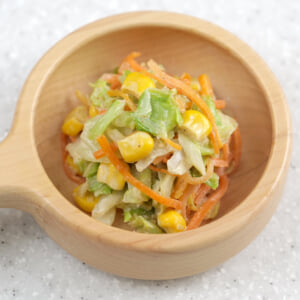
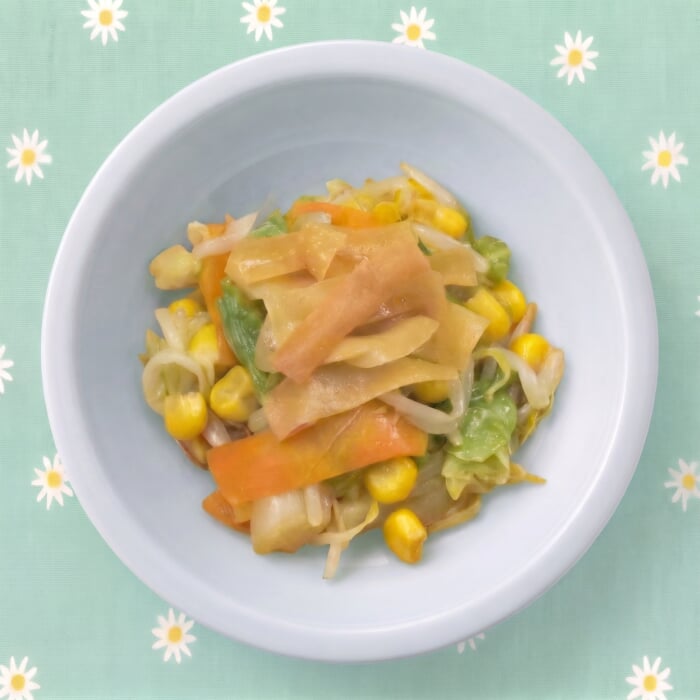
Pari pari is the Japanese word for a crisp, crackly crunch, and that is exactly what makes this salad a favorite at school lunch. Lightly boiled cabbage, carrot and bean sprouts are tossed with sweet corn in a simple soy-vinegar dressing, then topped with strips of deep-fried wonton wrapper just before serving. The crunchy topping turns a plain vegetable salad into something fun, and even children who are not keen on vegetables tend to dig in happily. The recipe is made without egg or milk.
Toddlers to adults. The whole family can eat this exactly as written.
Added. Open the recipe helper (bottom right) → ☰ Menu → 🛒 Shopping list to see the ingredients for your family size.
Printing uses the number of adults and children set under Ingredients, so set those first.
Ingredients
Amounts for 1 child (1 serving). An adult counts as 2 servings.
One serving here is 1.5× the portion served to a child in a Japanese preschool, sized for Western appetites. An adult counts as two servings. Tap an ingredient to check it off.
Ingredients
- 1.5 slice(s)wonton wrappers
- to tasteoil for deep-frying
- 45 gcabbage
- 15 gcarrot
- 45 gbean sprouts
- 18 gwhole kernel corn (canned)
Sauce Mixture (A)
- 4.5 gvinegar
- 3.6 gsugar
- 2.7 gvegetable oil
- 6.6 gsoy sauce
Directions
Video is in Japanese — the steps below are synced to it, so tap ▶ on a step to jump to that moment.
- 1
Put the ingredients for (A) in a microwave-safe container and mix well. Cover loosely with plastic wrap, leaving a gap for steam to escape, and microwave at 1200W for about 15 seconds (30 seconds at 600W). Let cool, then chill in the refrigerator. (The sugar tends to settle on the bottom, so mix it in well before heating.)
- 2
Cut the cabbage and carrot into short, thin rectangular strips. Boil them together with the bean sprouts in hot water for about 1 minute, drain in a colander and cool under running water. Squeeze out the water well, then chill in the refrigerator. (For elementary-school-age children and younger, boiling for about 3 minutes makes the vegetables softer and easier to eat.)
- 3
Tip the corn into a colander and drain well.
- 4
Cut the wonton wrappers into thin strips. Add them to oil heated to 170°C (340°F), separating the strips as you drop them in, and deep-fry for about 1 minute. (They burn easily, so lift them out as soon as they are lightly golden.)
- 5
Toss the vegetables from step 2 and the corn from step 3 with the dressing from step 1, arrange in a serving dish and top with the fried wonton strips from step 4. (Add the wonton strips just before eating so they stay crisp and crunchy.)
Tips for Best Results
- The key is to chill the vegetables and the dressing separately and toss them together just before eating. That way the salad doesn't turn watery and tastes its best.
- The fried wonton strips stay crisp even after sitting a while, so it's fine to fry them ahead of time. Their crunchy texture adds a fun accent that helps even children who are not fond of vegetables enjoy the salad.
Freezing and Storage
This salad is not suited to freezing. Keep it in the refrigerator and finish it by the next day.
Nutrition
| Per | 1 serving | 1 adult serving | Your total |
|---|---|---|---|
| Energy | 183 kcal | 366 kcal | 183 kcal |
| Protein | 3.2 g | 6.3 g | 3.2 g |
| Fat | 12 g | 24 g | 12 g |
| Carbohydrates | 17 g | 33.9 g | 17 g |
| Fiber | 2.6 g | 5.1 g | 2.6 g |
| Salt equivalent | 1 g | 2.1 g | 1 g |
| Calcium | 30 mg | 60 mg | 30 mg |
| Iron | 0.5 mg | 0.9 mg | 0.5 mg |
| Potassium | 222 mg | 444 mg | 222 mg |
| Phosphorus | 51 mg | 102 mg | 51 mg |
| Energy | Protein | Fat | Carbs | Fiber | Salt equiv. | Calcium | Iron | Potassium | Phosphorus | |
|---|---|---|---|---|---|---|---|---|---|---|
| 1 serving | 183 kcal | 3.2 g | 12 g | 17 g | 2.6 g | 1 g | 30 mg | 0.5 mg | 222 mg | 51 mg |
| 1 adult serving | 366 kcal | 6.3 g | 24 g | 33.9 g | 5.1 g | 2.1 g | 60 mg | 0.9 mg | 444 mg | 102 mg |
Values are per serving (1.5× the Japanese preschool portion); an adult serving is double. They were calculated by a licensed Japanese nutritionist using the Standard Tables of Food Composition in Japan. "Salt equivalent" is sodium × 2.54, the standard Japanese measure. Allergen flags cover egg, milk and wheat only and come from the nutritionist's records. Soy sauce and miso are made with wheat but are usually allowed on Japanese wheat-free school menus, so check with your doctor.
Cooking for bigger kids? See the elementary-school portion of this recipe.