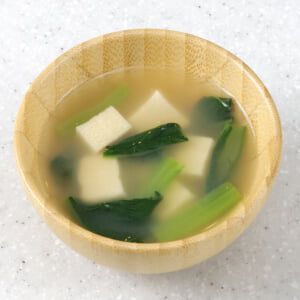
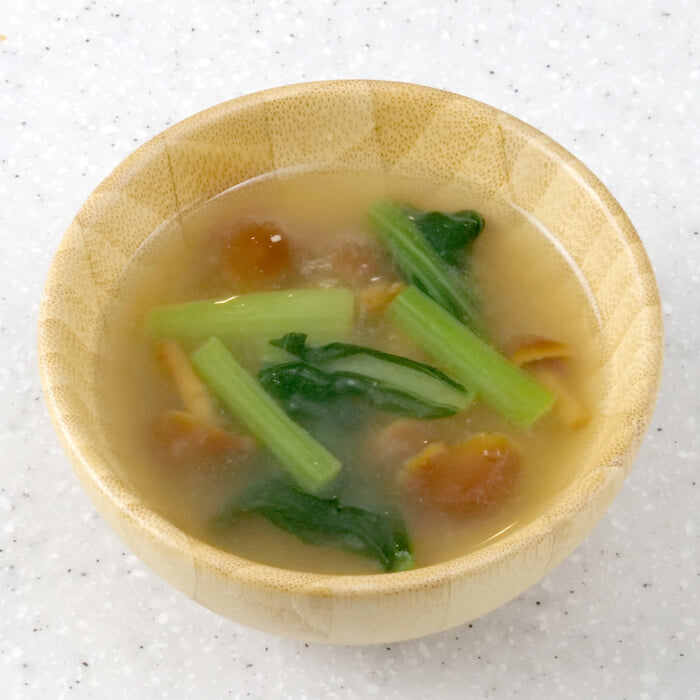
Miso Soup with Komatsuna and Nameko
みそ汁(小松菜・なめこ) · Misoshiru (Komatsuna, Nameko)
 By Aoi, licensed nutritionist · From a Japanese preschool lunch menu
Miso soup is the everyday soup of Japan, and at preschool it appears on the lunch tray again and again with whatever vegetables are in season. This version pairs komatsuna, a mild Japanese mustard green, with nameko, small mushrooms coated in a natural slippery gel that gives the broth a pleasant, silky body. The greens are boiled separately and stirred in at the very end so they stay bright and tender rather than stewed, and the soft, slippery mushrooms go down easily even for little ones who are still learning to chew. If you can't find komatsuna, spinach or baby bok choy makes a good stand-in.
Wheat-free, but uses miso (made with wheat). Japanese school-lunch allergy menus usually allow it, so check with your doctor. How to read the labels
Added. Open the recipe helper (bottom right) → ☰ Menu → 🛒 Shopping list to see the ingredients for your family size.
Printing uses the number of adults and children set under Ingredients, so set those first.
Ingredients
Amounts for 1 child (1 serving). An adult counts as 2 servings.
One serving here is 1.5× the portion served to a child in a Japanese preschool, sized for Western appetites. An adult counts as two servings. Tap an ingredient to check it off.
Ingredients
- 18 gkomatsunaA mild Japanese leafy green (Japanese mustard spinach) with tender stems. Substitute: Spinach or bok choy.
- 15 gnameko mushroomsSmall, amber-colored Japanese mushrooms with a naturally slippery coating, often used in miso soup. Substitute: Shimeji, enoki, or thinly sliced button mushrooms.
Seasonings
- 150 gdashi stockJapanese soup stock, usually made from kombu (dried kelp) and/or bonito flakes; the base of most Japanese soups and simmered dishes. Substitute: Instant dashi granules dissolved in water, or a mild unsalted chicken or vegetable stock.
- 4.5 gmisoFermented soybean paste. Salty and savory, it is Japan's everyday seasoning for miso soup and many simmered dishes. Substitute: Any light (white or awase) miso. Misos differ in saltiness, so start with a little less and taste. Some misos are made with barley or wheat, so check the label if you avoid them.
About the Japanese ingredients in this recipe
- komatsuna (こまつな)
- A mild Japanese leafy green (Japanese mustard spinach) with tender stems. Substitute: Spinach or bok choy.
- nameko mushrooms (なめこ)
- Small, amber-colored Japanese mushrooms with a naturally slippery coating, often used in miso soup. Substitute: Shimeji, enoki, or thinly sliced button mushrooms.
- dashi stock (だし汁)
- Japanese soup stock, usually made from kombu (dried kelp) and/or bonito flakes; the base of most Japanese soups and simmered dishes. Substitute: Instant dashi granules dissolved in water, or a mild unsalted chicken or vegetable stock.
- miso (みそ)
- Fermented soybean paste. Salty and savory, it is Japan's everyday seasoning for miso soup and many simmered dishes. Substitute: Any light (white or awase) miso. Misos differ in saltiness, so start with a little less and taste. Some misos are made with barley or wheat, so check the label if you avoid them.
Directions
- 1
Cut the komatsuna into 2 cm lengths and boil until tender.
- 2
Rinse the nameko mushrooms briefly and roughly chop any with large caps.
- 3
Bring the dashi stock to a boil in a pot, add the mushrooms from step 2 and simmer.
- 4
Dissolve the miso into the soup, then add the komatsuna from step 1 just before serving.
Nutrition
| Per | 1 serving | 1 adult serving | Your total |
|---|---|---|---|
| Energy | 15 kcal | 30 kcal | 15 kcal |
| Protein | 1.5 g | 3 g | 1.5 g |
| Fat | 0.3 g | 0.6 g | 0.3 g |
| Carbohydrates | 2.6 g | 5.1 g | 2.6 g |
| Fiber | 0.8 g | 1.5 g | 0.8 g |
| Salt equivalent | 0.8 g | 1.5 g | 0.8 g |
| Calcium | 39 mg | 78 mg | 39 mg |
| Iron | 0.8 mg | 1.5 mg | 0.8 mg |
| Potassium | 220.5 mg | 441 mg | 220.5 mg |
| Energy | Protein | Fat | Carbs | Fiber | Salt equiv. | Calcium | Iron | Potassium | |
|---|---|---|---|---|---|---|---|---|---|
| 1 serving | 15 kcal | 1.5 g | 0.3 g | 2.6 g | 0.8 g | 0.8 g | 39 mg | 0.8 mg | 220.5 mg |
| 1 adult serving | 30 kcal | 3 g | 0.6 g | 5.1 g | 1.5 g | 1.5 g | 78 mg | 1.5 mg | 441 mg |
Values are per serving (1.5× the Japanese preschool portion); an adult serving is double. They were calculated by a licensed Japanese nutritionist using the Standard Tables of Food Composition in Japan. "Salt equivalent" is sodium × 2.54, the standard Japanese measure. Allergen flags cover egg, milk and wheat only and come from the nutritionist's records. Soy sauce and miso are made with wheat but are usually allowed on Japanese wheat-free school menus, so check with your doctor.
Ingredients in this recipe
You might also like
All recipes →
Miso Soup with Daikon and Komatsuna
Miso Soup with Potato and Komatsuna
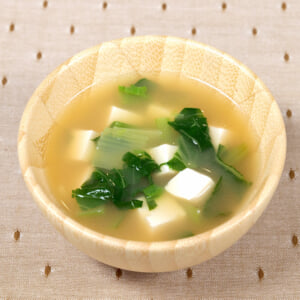
Miso Soup with Tofu and Komatsuna
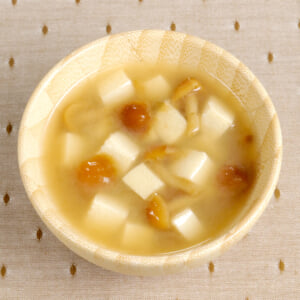
Miso Soup with Koya-dofu and Nameko Mushrooms
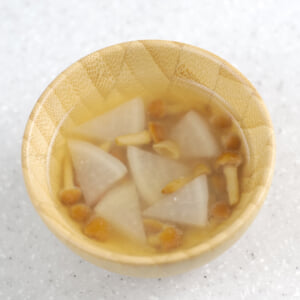
Miso Soup with Daikon and Nameko Mushrooms