Kokuto Chinsuko (Okinawan Shortbread)
黒糖ちんすこう · Kokuto Chinsuko
 By Aoi, licensed nutritionist · From a Japanese preschool lunch menu
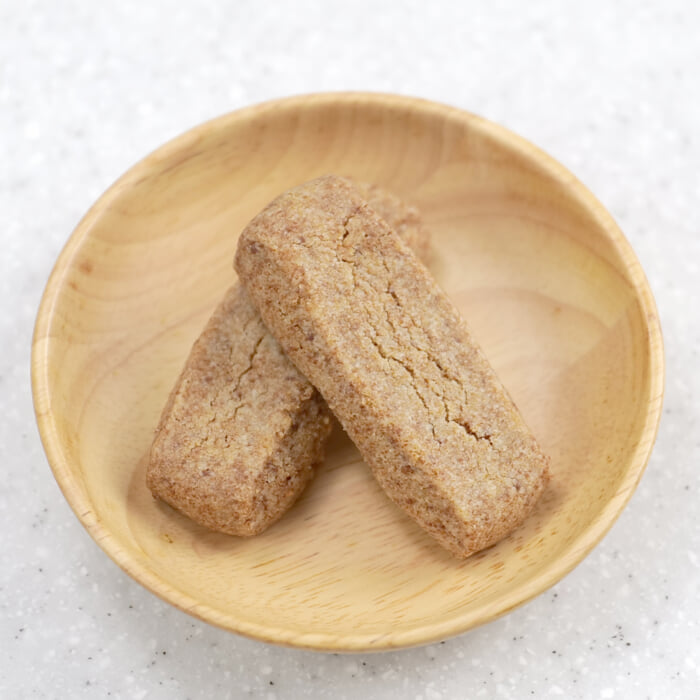
Chinsuko is a traditional cookie from Okinawa, Japan's southernmost islands - crumbly and sandy like a shortbread, and classically made with flour, sugar and lard. This version uses vegetable oil instead, and sweetens the dough with kokuto, the dark, unrefined sugar made from Okinawan sugarcane that has a deep, almost molasses-like flavor. With only three ingredients and no eggs or dairy, it is an easy afternoon snack for the preschool kitchen, and children love pressing and shaping the dough themselves.
Contains kokuto (Japanese brown sugar), which should not be given to babies under 1 year old.
Added. Open the recipe helper (bottom right) → ☰ Menu → 🛒 Shopping list to see the ingredients for your family size.
Printing uses the number of adults and children set under Ingredients, so set those first.
Ingredients
Amounts for 1 child (1 serving). An adult counts as 2 servings.
One serving here is 1.5× the portion served to a child in a Japanese preschool, sized for Western appetites. An adult counts as two servings. Tap an ingredient to check it off.
Ingredients
- 30 gflour
Seasonings
- 9 gkokuto (Japanese brown sugar)An unrefined dark cane sugar from Okinawa with a deep, molasses-like flavor. Substitute: Dark brown sugar or muscovado.
- 12 gvegetable oil
About the Japanese ingredients in this recipe
- kokuto (Japanese brown sugar) (黒砂糖)
- An unrefined dark cane sugar from Okinawa with a deep, molasses-like flavor. Substitute: Dark brown sugar or muscovado.
Directions
- 1
Put the flour and kokuto in a bowl and whisk well to combine.
- 2
Add the oil and mix with your hands until the dough comes together in one mass.
- 3
Roll or pat the dough out to about 1 cm thick and cut it into rectangles with a knife (or shape it into sticks by hand).
- 4
Place the pieces on a baking sheet lined with parchment paper and bake in a toaster oven (or an oven preheated to 170°C (340°F)) for about 15 minutes.
For children under 1 year old, make these with regular white sugar instead of kokuto. The cookies are still soft when they come out of the oven, so let them cool completely before plating.
Nutrition
| Per | 1 serving | 1 adult serving | Your total |
|---|---|---|---|
| Energy | 243 kcal | 486 kcal | 243 kcal |
| Protein | 2.7 g | 5.4 g | 2.7 g |
| Fat | 12.5 g | 24.9 g | 12.5 g |
| Carbohydrates | 30.9 g | 61.8 g | 30.9 g |
| Fiber | 0.8 g | 1.5 g | 0.8 g |
| Salt equivalent | 0 g | 0 g | 0 g |
| Calcium | 27 mg | 54 mg | 27 mg |
| Iron | 0.6 mg | 1.2 mg | 0.6 mg |
| Potassium | 132 mg | 264 mg | 132 mg |
| Energy | Protein | Fat | Carbs | Fiber | Salt equiv. | Calcium | Iron | Potassium | |
|---|---|---|---|---|---|---|---|---|---|
| 1 serving | 243 kcal | 2.7 g | 12.5 g | 30.9 g | 0.8 g | 0 g | 27 mg | 0.6 mg | 132 mg |
| 1 adult serving | 486 kcal | 5.4 g | 24.9 g | 61.8 g | 1.5 g | 0 g | 54 mg | 1.2 mg | 264 mg |
Values are per serving (1.5× the Japanese preschool portion); an adult serving is double. They were calculated by a licensed Japanese nutritionist using the Standard Tables of Food Composition in Japan. "Salt equivalent" is sodium × 2.54, the standard Japanese measure. Allergen flags cover egg, milk and wheat only and come from the nutritionist's records. Soy sauce and miso are made with wheat but are usually allowed on Japanese wheat-free school menus, so check with your doctor.