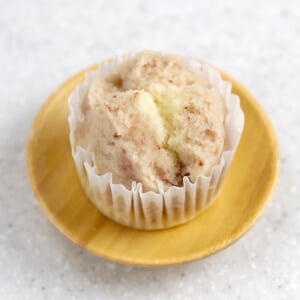
Doughnuts
ドーナツ
 By Aoi, licensed nutritionist · From a Japanese preschool lunch menu
These little drop doughnuts are a much-loved afternoon snack in Japanese preschool kitchens. There is no rolling or cutting: you simply whisk up a quick batter, scoop it with a spoon and drop it into the oil, so they come out as soft, lightly sweet, bite-sized puffs that small hands can manage easily. A little potato starch in the batter keeps the texture tender, and frying at a lower temperature lets them cook through gently without browning too fast.
Added. Open the recipe helper (bottom right) → ☰ Menu → 🛒 Shopping list to see the ingredients for your family size.
Printing uses the number of adults and children set under Ingredients, so set those first.

Ingredients
Amounts for 1 child (1 serving). An adult counts as 2 servings.
One serving here is 1.5× the portion served to a child in a Japanese preschool, sized for Western appetites. An adult counts as two servings. Tap an ingredient to check it off.
Ingredients
- 30 gflour
- 10.5 gegg
Seasonings
- 7.5 gpotato starch (katakuriko)Japanese potato starch used for thickening sauces and coating fried foods. Substitute: Cornstarch: start with the same amount and add a little more if it is still thin. It thickens a little less than potato starch and needs a couple of minutes at a gentle bubble to reach full thickness.
- 1.5 gbaking powder
- 7.5 gsugar
- 18 mlmilk
- 4.5 gvegetable oil
About the Japanese ingredients in this recipe
- potato starch (katakuriko) (かたくり粉)
- Japanese potato starch used for thickening sauces and coating fried foods. Substitute: Cornstarch: start with the same amount and add a little more if it is still thin. It thickens a little less than potato starch and needs a couple of minutes at a gentle bubble to reach full thickness. Read the guide: Katakuriko (Japanese Potato Starch) and What to Use Instead → Guide: japanese-school-lunch.com/articles/katakuriko-potato-starch/
Directions
- 1
Put the flour, potato starch, baking powder and sugar in a bowl and mix with a whisk.
- 2
Add the beaten egg and milk and mix well.
- 3
Heat the oil to 160°C (320°F), scoop up the batter with a spoon, drop it into the oil and fry. (Tip: pour a little oil into a small container and rest the spoon in it before scooping the batter - the batter will slide off the spoon much more easily.)
If the oil is too hot, the outside browns quickly before the inside is done, so fry at a low temperature and keep an eye on it to make sure the heat doesn't climb too high.
Nutrition
| Per | 1 serving | 1 adult serving | Your total |
|---|---|---|---|
| Energy | 229.5 kcal | 459 kcal | 229.5 kcal |
| Protein | 4.5 g | 9 g | 4.5 g |
| Fat | 6.8 g | 13.5 g | 6.8 g |
| Carbohydrates | 37.8 g | 75.6 g | 37.8 g |
| Fiber | 0.8 g | 1.5 g | 0.8 g |
| Salt equivalent | 0.3 g | 0.6 g | 0.3 g |
| Calcium | 67.5 mg | 135 mg | 67.5 mg |
| Iron | 0.3 mg | 0.6 mg | 0.3 mg |
| Potassium | 135 mg | 270 mg | 135 mg |
| Energy | Protein | Fat | Carbs | Fiber | Salt equiv. | Calcium | Iron | Potassium | |
|---|---|---|---|---|---|---|---|---|---|
| 1 serving | 229.5 kcal | 4.5 g | 6.8 g | 37.8 g | 0.8 g | 0.3 g | 67.5 mg | 0.3 mg | 135 mg |
| 1 adult serving | 459 kcal | 9 g | 13.5 g | 75.6 g | 1.5 g | 0.6 g | 135 mg | 0.6 mg | 270 mg |
Values are per serving (1.5× the Japanese preschool portion); an adult serving is double. They were calculated by a licensed Japanese nutritionist using the Standard Tables of Food Composition in Japan. "Salt equivalent" is sodium × 2.54, the standard Japanese measure. Allergen flags cover egg, milk and wheat only and come from the nutritionist's records. Soy sauce and miso are made with wheat but are usually allowed on Japanese wheat-free school menus, so check with your doctor.