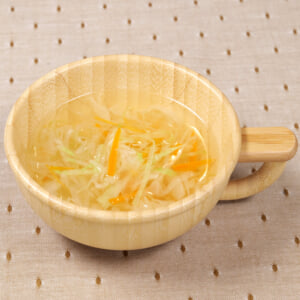
Vegetable Soup with Cabbage and Bean Sprouts
野菜スープ(キャベツ・もやし)
 By Aoi, licensed nutritionist · From a Japanese preschool lunch menu
Clear, consommé-based vegetable soups like this one turn up again and again on Japanese preschool lunch menus, usually alongside a Western-style main dish. This version pairs sweet cabbage with bean sprouts, both cut small so they fit neatly on a child's spoon and soften quickly in the broth. The seasoning is deliberately gentle: the vegetables give the soup most of its flavor, and a small pinch of salt at the end is all it needs.
Added. Open the recipe helper (bottom right) → ☰ Menu → 🛒 Shopping list to see the ingredients for your family size.
Printing uses the number of adults and children set under Ingredients, so set those first.
Ingredients
Amounts for 1 child (1 serving). An adult counts as 2 servings.
One serving here is 1.5× the portion served to a child in a Japanese preschool, sized for Western appetites. An adult counts as two servings. Tap an ingredient to check it off.
Ingredients
- 22.5 gcabbage
- 19.5 gbean sprouts
Seasonings
- 150 mlwater
- 0.8 gconsommé bouillon (granules or cube)Japanese-style Western soup stock powder or cubes, similar to chicken or vegetable bouillon. Substitute: Chicken or vegetable bouillon granules or a bouillon cube.
- 0.3 gsalt
About the Japanese ingredients in this recipe
- consommé bouillon (granules or cube) (コンソメ)
- Japanese-style Western soup stock powder or cubes, similar to chicken or vegetable bouillon. Substitute: Chicken or vegetable bouillon granules or a bouillon cube.
Directions
- 1
Cut the cabbage into 1 cm squares and the bean sprouts into 2 cm lengths.
- 2
Put the water and consommé bouillon in a pot and bring to a boil, then add the cabbage and bean sprouts from step 1 and simmer.
- 3
Once the vegetables are tender, add the salt to adjust the seasoning.
Nutrition
| Per | 1 serving | 1 adult serving | Your total |
|---|---|---|---|
| Energy | 9 kcal | 18 kcal | 9 kcal |
| Protein | 0.6 g | 1.2 g | 0.6 g |
| Fat | 0 g | 0 g | 0 g |
| Carbohydrates | 2 g | 3.9 g | 2 g |
| Fiber | 0.8 g | 1.5 g | 0.8 g |
| Salt equivalent | 0.6 g | 1.2 g | 0.6 g |
| Calcium | 10.5 mg | 21 mg | 10.5 mg |
| Iron | 0 mg | 0 mg | 0 mg |
| Potassium | 60 mg | 120 mg | 60 mg |
| Energy | Protein | Fat | Carbs | Fiber | Salt equiv. | Calcium | Iron | Potassium | |
|---|---|---|---|---|---|---|---|---|---|
| 1 serving | 9 kcal | 0.6 g | 0 g | 2 g | 0.8 g | 0.6 g | 10.5 mg | 0 mg | 60 mg |
| 1 adult serving | 18 kcal | 1.2 g | 0 g | 3.9 g | 1.5 g | 1.2 g | 21 mg | 0 mg | 120 mg |
Values are per serving (1.5× the Japanese preschool portion); an adult serving is double. They were calculated by a licensed Japanese nutritionist using the Standard Tables of Food Composition in Japan. "Salt equivalent" is sodium × 2.54, the standard Japanese measure. Allergen flags cover egg, milk and wheat only and come from the nutritionist's records. Soy sauce and miso are made with wheat but are usually allowed on Japanese wheat-free school menus, so check with your doctor.