Okonomiyaki (Japanese Savory Pancake) (Egg-Free)
お好み焼き(卵なし) · Okonomiyaki
 By Aoi, licensed nutritionist · From a Japanese preschool lunch menu
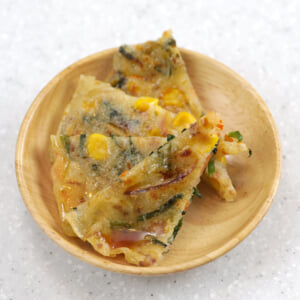
Okonomiyaki is Japan's beloved savory pancake, packed with cabbage and pork and finished with a sweet-tangy brown sauce. This version is made without egg: silken tofu goes straight into the batter (no draining needed) to hold everything together and keep the inside soft and moist, which is just right for little mouths. It is served as an afternoon snack at preschool, and the familiar sauce-and-seaweed topping makes it an easy win with children who are otherwise wary of vegetables.
Added. Open the recipe helper (bottom right) → ☰ Menu → 🛒 Shopping list to see the ingredients for your family size.
Printing uses the number of adults and children set under Ingredients, so set those first.
Ingredients
Amounts for 1 child (1 serving). An adult counts as 2 servings.
One serving here is 1.5× the portion served to a child in a Japanese preschool, sized for Western appetites. An adult counts as two servings. Tap an ingredient to check it off.
Ingredients
- 15 gthinly sliced pork (komagire)Small, thin offcuts of pork sold in Japan for quick stir-fries and simmered dishes. Substitute: Thinly sliced pork shoulder or loin cut into bite-size pieces.
- 45 gsilken tofu
- 37.5 gcabbage
- 4.5 gflour
- 4.5 gpotato starch (katakuriko)Japanese potato starch used for thickening sauces and coating fried foods. Substitute: Cornstarch: start with the same amount and add a little more if it is still thin. It thickens a little less than potato starch and needs a couple of minutes at a gentle bubble to reach full thickness.
- 0.9 gkatsuobushi (dried bonito flakes)Paper-thin shavings of dried, smoked skipjack tuna that add a savory, smoky depth as a topping or stock base. Substitute: A pinch of dashi powder, or omit.
- 0.1 gaonori (green seaweed flakes)Fine, fragrant flakes of dried green seaweed sprinkled over dishes like okonomiyaki and yakisoba. Substitute: Crumbled nori sheets, or omit.
Seasonings
- 0.8 gvegetable oil
- 2.3 gvegetable oil
- 4.5 gchuno sauce (Japanese medium-thick brown sauce)A sweet, tangy, fruit-and-vegetable-based brown sauce that sits between thin Worcestershire and thick tonkatsu sauce. Substitute: Tonkatsu sauce, or Worcestershire sauce mixed with a little ketchup.
About the Japanese ingredients in this recipe
- thinly sliced pork (komagire) (豚こま切れ肉)
- Small, thin offcuts of pork sold in Japan for quick stir-fries and simmered dishes. Substitute: Thinly sliced pork shoulder or loin cut into bite-size pieces.
- potato starch (katakuriko) (かたくり粉)
- Japanese potato starch used for thickening sauces and coating fried foods. Substitute: Cornstarch: start with the same amount and add a little more if it is still thin. It thickens a little less than potato starch and needs a couple of minutes at a gentle bubble to reach full thickness. Read the guide: Katakuriko (Japanese Potato Starch) and What to Use Instead → Guide: japanese-school-lunch.com/articles/katakuriko-potato-starch/
- katsuobushi (dried bonito flakes) (かつお削り節)
- Paper-thin shavings of dried, smoked skipjack tuna that add a savory, smoky depth as a topping or stock base. Substitute: A pinch of dashi powder, or omit.
- chuno sauce (Japanese medium-thick brown sauce) (中濃ソース)
- A sweet, tangy, fruit-and-vegetable-based brown sauce that sits between thin Worcestershire and thick tonkatsu sauce. Substitute: Tonkatsu sauce, or Worcestershire sauce mixed with a little ketchup.
- aonori (green seaweed flakes) (あおのり)
- Fine, fragrant flakes of dried green seaweed sprinkled over dishes like okonomiyaki and yakisoba. Substitute: Crumbled nori sheets, or omit.
Directions
- 1
Cut the pork into 1 cm wide strips and cook it in a frying pan with a little oil. Roughly chop the cabbage.
- 2
In a bowl, combine the tofu (no need to drain it), the pork and cabbage from step 1, the flour, potato starch and katsuobushi, and mix well.
- 3
Oil the frying pan, pour in the batter and spread it out, then cook over medium heat. Flip it over, reduce to low heat, cover with a lid and cook until done.
- 4
Once cooked through, brush the top with the sauce, sprinkle with aonori and cut into pieces.
Nutrition
| Per | 1 serving | 1 adult serving | Your total |
|---|---|---|---|
| Energy | 124.5 kcal | 249 kcal | 124.5 kcal |
| Protein | 7.1 g | 14.1 g | 7.1 g |
| Fat | 6.1 g | 12.3 g | 6.1 g |
| Carbohydrates | 11.3 g | 22.5 g | 11.3 g |
| Fiber | 1.4 g | 2.7 g | 1.4 g |
| Salt equivalent | 0.3 g | 0.6 g | 0.3 g |
| Calcium | 55.5 mg | 111 mg | 55.5 mg |
| Iron | 1.2 mg | 2.4 mg | 1.2 mg |
| Potassium | 216 mg | 432 mg | 216 mg |
| Energy | Protein | Fat | Carbs | Fiber | Salt equiv. | Calcium | Iron | Potassium | |
|---|---|---|---|---|---|---|---|---|---|
| 1 serving | 124.5 kcal | 7.1 g | 6.1 g | 11.3 g | 1.4 g | 0.3 g | 55.5 mg | 1.2 mg | 216 mg |
| 1 adult serving | 249 kcal | 14.1 g | 12.3 g | 22.5 g | 2.7 g | 0.6 g | 111 mg | 2.4 mg | 432 mg |
Values are per serving (1.5× the Japanese preschool portion); an adult serving is double. They were calculated by a licensed Japanese nutritionist using the Standard Tables of Food Composition in Japan. "Salt equivalent" is sodium × 2.54, the standard Japanese measure. Allergen flags cover egg, milk and wheat only and come from the nutritionist's records. Soy sauce and miso are made with wheat but are usually allowed on Japanese wheat-free school menus, so check with your doctor.