Chinese-Style Soup with Onion and Komatsuna
中華スープ(玉ねぎ・小松菜) · Chuka Soup
 By Aoi, licensed nutritionist · From a Japanese preschool lunch menu
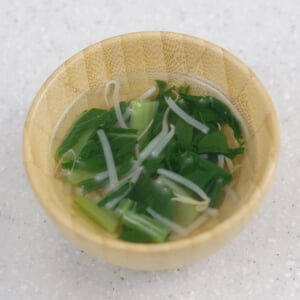
This simple, clear soup is a staple on Japanese school lunch menus whenever a Chinese-style main dish is served. Thinly sliced onion simmers in chicken stock until it turns soft and sweet, and komatsuna (a mild Japanese leafy green, similar to spinach without the bitterness) is added at the very end so it keeps its bright color and tender bite. The seasoning is kept gentle, so even young children who are wary of leafy greens tend to finish their bowls.
Added. Open the recipe helper (bottom right) → ☰ Menu → 🛒 Shopping list to see the ingredients for your family size.
Printing uses the number of adults and children set under Ingredients, so set those first.
Ingredients
Amounts for 1 child (1 serving). An adult counts as 2 servings.
One serving here is 1.5× the portion served to a child in a Japanese preschool, sized for Western appetites. An adult counts as two servings. Tap an ingredient to check it off.
Ingredients
- 15 gonion
- 18 gkomatsunaA mild Japanese leafy green (Japanese mustard spinach) with tender stems. Substitute: Spinach or bok choy.
Seasonings
- 150 mlwater
- 0.6 gchicken stock powder (Chinese-style)Japanese granulated chicken bone soup base used for Chinese-style soups and stir-fries. Substitute: Chicken bouillon granules or powder.
- 0.3 gsalt
About the Japanese ingredients in this recipe
- komatsuna (こまつな)
- A mild Japanese leafy green (Japanese mustard spinach) with tender stems. Substitute: Spinach or bok choy.
- chicken stock powder (Chinese-style) (鶏ガラスープの素)
- Japanese granulated chicken bone soup base used for Chinese-style soups and stir-fries. Substitute: Chicken bouillon granules or powder.
Directions
- 1
Cut the komatsuna into 2 cm lengths and boil it.
- 2
Cut the onion in half lengthwise, then into thin slices.
- 3
Put the water and chicken stock powder in a pot and bring to a boil, then add the onion from step 2 and simmer.
- 4
Once the onion is soft, season with salt and add the komatsuna from step 1 just before serving.
Nutrition
| Per | 1 serving | 1 adult serving | Your total |
|---|---|---|---|
| Energy | 7.5 kcal | 15 kcal | 7.5 kcal |
| Protein | 0.5 g | 0.9 g | 0.5 g |
| Fat | 0 g | 0 g | 0 g |
| Carbohydrates | 1.7 g | 3.3 g | 1.7 g |
| Fiber | 0.6 g | 1.2 g | 0.6 g |
| Salt equivalent | 0.3 g | 0.6 g | 0.3 g |
| Calcium | 33 mg | 66 mg | 33 mg |
| Iron | 0.5 mg | 0.9 mg | 0.5 mg |
| Potassium | 112.5 mg | 225 mg | 112.5 mg |
| Energy | Protein | Fat | Carbs | Fiber | Salt equiv. | Calcium | Iron | Potassium | |
|---|---|---|---|---|---|---|---|---|---|
| 1 serving | 7.5 kcal | 0.5 g | 0 g | 1.7 g | 0.6 g | 0.3 g | 33 mg | 0.5 mg | 112.5 mg |
| 1 adult serving | 15 kcal | 0.9 g | 0 g | 3.3 g | 1.2 g | 0.6 g | 66 mg | 0.9 mg | 225 mg |
Values are per serving (1.5× the Japanese preschool portion); an adult serving is double. They were calculated by a licensed Japanese nutritionist using the Standard Tables of Food Composition in Japan. "Salt equivalent" is sodium × 2.54, the standard Japanese measure. Allergen flags cover egg, milk and wheat only and come from the nutritionist's records. Soy sauce and miso are made with wheat but are usually allowed on Japanese wheat-free school menus, so check with your doctor.