Spinach Gratin (Milk-Free)
ほうれん草のグラタン(乳なし)
 By Aoi, licensed nutritionist · From a Japanese preschool lunch menu
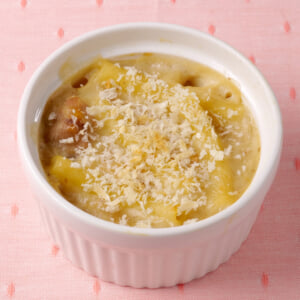
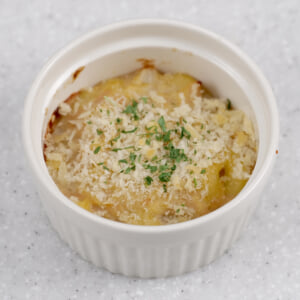
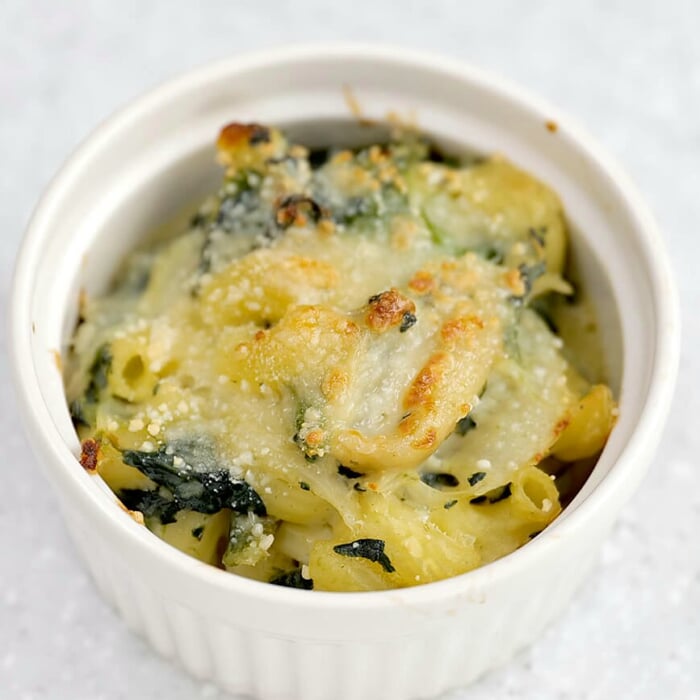
Gratin is a firm favorite on Japanese preschool lunch menus, and this version leaves out the dairy entirely: the creamy white sauce is made with soy milk instead of milk and butter. Tender chicken, soft macaroni and finely chopped spinach are folded into the sauce, then baked under a scattering of panko until the top turns golden and crisp. The mild, gentle flavor makes it an easy way to get spinach onto little plates.
Added. Open the recipe helper (bottom right) → ☰ Menu → 🛒 Shopping list to see the ingredients for your family size.
Printing uses the number of adults and children set under Ingredients, so set those first.
Ingredients
Amounts for 1 child (1 serving). An adult counts as 2 servings.
One serving here is 1.5× the portion served to a child in a Japanese preschool, sized for Western appetites. An adult counts as two servings. Tap an ingredient to check it off.
Ingredients
- 30 gchicken thigh
- 30 gonion
- 27 gspinach
- 7.5 gmacaroni
Seasonings
- 3.8 gvegetable oil
- 4.5 gflour
- 63 gsweetened soy milk (Japanese chosei tonyu)Japanese 'prepared' soy milk that is lightly sweetened and flavored to taste milder than plain soy milk. Substitute: Regular (original, lightly sweetened) soy milk from the supermarket.
- 0.3 gsalt
- 0.2 gconsommé bouillon (allergen-free)Japanese-style consommé stock granules or cubes, used as a Western-style soup base. This kind is made without egg and milk, but most recipes on this site that use it list wheat in their allergens, so check the label if you avoid wheat. Substitute: A chicken or vegetable bouillon powder or cube made without egg, milk or wheat (check the label).
- 1.5 gpanko
About the Japanese ingredients in this recipe
- sweetened soy milk (Japanese chosei tonyu) (調製豆乳)
- Japanese 'prepared' soy milk that is lightly sweetened and flavored to taste milder than plain soy milk. Substitute: Regular (original, lightly sweetened) soy milk from the supermarket.
- consommé bouillon (allergen-free) (コンソメ(アレルゲン不使用))
- Japanese-style consommé stock granules or cubes, used as a Western-style soup base. This kind is made without egg and milk, but most recipes on this site that use it list wheat in their allergens, so check the label if you avoid wheat. Substitute: A chicken or vegetable bouillon powder or cube made without egg, milk or wheat (check the label).
Directions
- 1
Cut the chicken into 1 cm dice and thinly slice the onion, then cut the slices in half lengthwise. Cut the spinach into 2 cm pieces and boil it, then squeeze out the water well. Boil the macaroni.
- 2
Heat the oil in a pot and sauté the onion. Add the chicken and sauté. Turn off the heat, sprinkle in the flour and stir until no dry flour remains, then return to low heat and stir in the soy milk.
- 3
Once the sauce begins to thicken, turn off the heat and stir in the macaroni and spinach. Add the salt and consommé bouillon.
- 4
Pour the mixture onto a baking sheet lined with parchment paper. Scatter panko over the top and bake in an oven preheated to 200°C (400°F) for about 15 minutes.
Nutrition
| Per | 1 serving | 1 adult serving | Your total |
|---|---|---|---|
| Energy | 189 kcal | 378 kcal | 189 kcal |
| Protein | 9.1 g | 18.3 g | 9.1 g |
| Fat | 10.5 g | 21 g | 10.5 g |
| Carbohydrates | 16.7 g | 33.3 g | 16.7 g |
| Fiber | 2.7 g | 5.4 g | 2.7 g |
| Salt equivalent | 0.5 g | 0.9 g | 0.5 g |
| Calcium | 42 mg | 84 mg | 42 mg |
| Iron | 1.8 mg | 3.6 mg | 1.8 mg |
| Potassium | 447 mg | 894 mg | 447 mg |
| Energy | Protein | Fat | Carbs | Fiber | Salt equiv. | Calcium | Iron | Potassium | |
|---|---|---|---|---|---|---|---|---|---|
| 1 serving | 189 kcal | 9.1 g | 10.5 g | 16.7 g | 2.7 g | 0.5 g | 42 mg | 1.8 mg | 447 mg |
| 1 adult serving | 378 kcal | 18.3 g | 21 g | 33.3 g | 5.4 g | 0.9 g | 84 mg | 3.6 mg | 894 mg |
Values are per serving (1.5× the Japanese preschool portion); an adult serving is double. They were calculated by a licensed Japanese nutritionist using the Standard Tables of Food Composition in Japan. "Salt equivalent" is sodium × 2.54, the standard Japanese measure. Allergen flags cover egg, milk and wheat only and come from the nutritionist's records. Soy sauce and miso are made with wheat but are usually allowed on Japanese wheat-free school menus, so check with your doctor.